
Healthy vs. Dangerous Compromise | Inspiring WithInn

Healthy Compromise vs. Dangerous Compromise: Are You Abandoning Yourself to Keep the Peace?
On this blog, I talk a lot about how to care for yourself better. That usually encompasses things like diet, exercise, and other healthy habits. But, if I’m honest, I’ve neglected one of the most essential parts of our health and wellness so far: our spiritual health.”
Spiritual health is about the condition of your relationship with God. It gives you purpose, grounds you in truth, guides your decisions, and shapes how you see yourself and the world around you. And because your spiritual health directly affects your mental, emotional, and even physical well-being, we need to regularly examine where we may be spiritually depleted, weak, or disconnected.
In my experience as a coach, one of the greatest threats to our spiritual health is dangerous compromise. Our culture has convinced us that being kind and loving means bending our values to accommodate worldly standards. But does that actually serve us? And, more importantly, is it biblical?
Let’s talk about it:
What Does It Mean to Compromise?
Compromise means making an adjustment or concession in response to another person or situation. Sometimes, that means two people meeting halfway. Other times, it means one person bending while the other person changes nothing.
And compromise isn’t always bad! In healthy situations, it allows us to be flexible, consider other people’s needs, and build stronger relationships. In fact, Philippians 2:4 tells us, “Let each of you look not only to his own interests, but also to the interests of others.” Being willing to listen, consider another person’s perspective, and adjust when appropriate reflects maturity and Christlike humility.
But there’s a big difference between adjusting your preferences and abandoning your principles. Choosing a restaurant you don’t love is flexibility. Ignoring your convictions, allowing someone to cross your boundaries, or accepting behavior that harms your well-being just to keep the peace is dangerous compromise.
So, the question isn’t whether you should ever compromise. It’s whether you’re adjusting something flexible or surrendering something God never asked you to give up.
The Difference Between Healthy and Dangerous Compromise
Do you consider yourself a people-pleaser? Someone who avoids conflict? An approval seeker? A passive communicator? Maybe even codependent? If any of those descriptions sound familiar, you may be a chronic compromiser. And it could be the very reason you feel so exhausted, resentful, overlooked, or disconnected from yourself.
But how do you know when it’s a good compromise and when it’s a bad compromise? If you’re used to being overly accommodating and self-sacrificing, the line can be really hard to see. You may have spent so long prioritizing everyone else’s comfort that ignoring your own needs feels normal. That’s why I’m laying out the difference between healthy and dangerous compromise:
Healthy Compromise
Healthy compromise means adjusting your preferences, opinions, or expectations without abandoning yourself in the process. You’re considering another person’s needs and practicing flexibility, but you aren’t violating your values, ignoring your boundaries, or sacrificing your well-being.
Examples of healthy compromise include:
Dividing household responsibilities in a way that works for both partners
Adjusting a holiday tradition to accommodate both sides of the family
Taking turns choosing activities, restaurants, or vacation plans
Leaving work early once a month to help with an event at church
Rescheduling plans to drive a friend to an important medical appointment
Meeting a friend closer to their home because they have a busier day
Changing dinner plans because someone in the group has dietary restrictions
Keeping the thermostat a little warmer or cooler than you prefer
Going to an event that matters to someone you love, even if it isn’t your thing
Dangerous Compromise
Dangerous compromise asks you to surrender something that shouldn’t be negotiable, such as your values, boundaries, identity, health, or God-given calling. Instead of creating a solution that considers both people, it requires you to continually make yourself smaller to avoid conflict, gain approval, or maintain a false sense of peace.
Examples of dangerous compromise include:
Staying with a partner who continually lies to, controls, or belittles you because you’re afraid they won’t be okay without your support
Allowing a friend or family member to insult you because speaking up might cause conflict
Skipping meals, workouts, rest, or quiet time whenever someone else wants your attention
Giving away money you need for your own bills because you’re afraid setting a limit means you aren’t being generous with what God has given you
Drinking more than you’re comfortable with because you don’t want to seem uptight
Joining in on gossip because you want to feel included
Laughing at inappropriate jokes because you don’t want to make the group uncomfortable
Staying quiet about unbiblical behavior from a church leader because you’re afraid of losing your church community
Agreeing to host another gathering when you’re already exhausted
Saying yes to another responsibility at church because no one else volunteered
Changing how you dress, speak, or express yourself to avoid someone’s criticism
Allowing relatives to overrule your parenting decisions to prevent family tension
Hiding your faith or convictions at work because you’re afraid of being judged
Apologizing simply to end an argument, even when you didn’t do anything wrong
Signs You’re Compromising Your Standards, Boundaries, or Identity
Dangerous compromise isn’t always obvious, especially when you’ve convinced yourself that you’re simply being kind, generous, or easygoing. But over time, the effects begin to show up in how you feel, how you make decisions, and how much of yourself you’re willing to give up for others. Here are some signs that flexibility may have crossed the line into self-abandonment:
Saying yes when you know God is telling you no
Tolerating treatment that contradicts your worth
Staying in unhealthy relationships because you fear being alone
Neglecting your needs and routines to keep everyone else happy
Hiding or minimizing parts of yourself to gain approval
Shrinking your calling because it makes someone else uncomfortable
Ignoring your boundaries to avoid conflict
Making choices that don’t align with your values
Feeling resentful, depleted, or disconnected from yourself
Constantly justifying behavior you know isn’t healthy
Prioritizing peacekeeping over telling the truth
No longer recognizing the person you’ve become

Why We Compromise Ourselves to Keep the Peace
There are so many reasons we as Christians tend to compromise our values and identity to keep the peace. It could have started a long time ago. As a child, you may have learned that being agreeable and endlessly selfless earned you love and safety instead of constant aggression or conflict. Or maybe, as an adult, you’ve mistakenly believed that constantly putting yourself last makes you a good Christian.
But we’ve forgotten the order: It’s not others, then ourselves, and then God. It’s God, others, and then ourselves. That’s a really important distinction. If you know God has called you to abstain from drinking because of a personal temptation or conviction, He doesn’t want you to partake just to make someone else feel more comfortable. Or, if God has called you into a season of rest so you can focus on Him, He doesn’t want you volunteering more at church simply because the congregation would appreciate it.
Do you see the difference? You’re not necessarily serving others before yourself. You may actually be serving others before the living God. I don’t say that to judge or shame you, but to lovingly convict you and help restore the right order. Christians are called to serve, sacrifice, and love others deeply, but that does not mean becoming passive doormats who accept whatever is thrown our way. You can be kind without abandoning your convictions, generous without ignoring your limits, and loving without sacrificing the person God called you to be.
What Does the Bible Say About Compromising Your Values?
Obey God rather than seek approval from people.
“Peter and the other apostles replied: “We must obey God rather than human beings!” — Acts 5:29
Refuse to conform to the patterns of the world.
“Do not conform to the pattern of this world, but be transformed by the renewing of your mind. Then you will be able to test and approve what God’s will is—his good, pleasing and perfect will.” — Romans 12:2
Stand firm in our faith and convictions.
“Be watchful, stand firm in the faith, act like men, be strong.” — 1 Corinthians 16:13
Guard our hearts carefully.
“Keep your heart with all vigilance, for from it flow the springs of life.” — Proverbs 4:23
Speak the truth in love.
“Instead, we will speak the truth in love, growing in every way more and more like Christ, who is the head of his body, the church.” — Ephesians 4:15
Avoid relationships that pull us away from God.
“Do not be deceived: ‘Bad company ruins good morals.’” — 1 Corinthians 15:33
Let our yes mean yes and our no mean no.
“Just say a simple, ‘Yes, I will,’ or ‘No, I won’t.’ Anything beyond this is from the evil one.” — Matthew 5:37
Choose integrity, even when no one else is watching.
“Whoever walks in integrity walks securely, but he who makes his ways crooked will be found out.” — Proverbs 10:9
Walk away from temptation instead of entertaining it.
“Flee the evil desires of youth and pursue righteousness, faith, love and peace, along with those who call on the Lord out of a pure heart.” — 2 Timothy 2:22
Remember that pleasing God matters more than pleasing people.
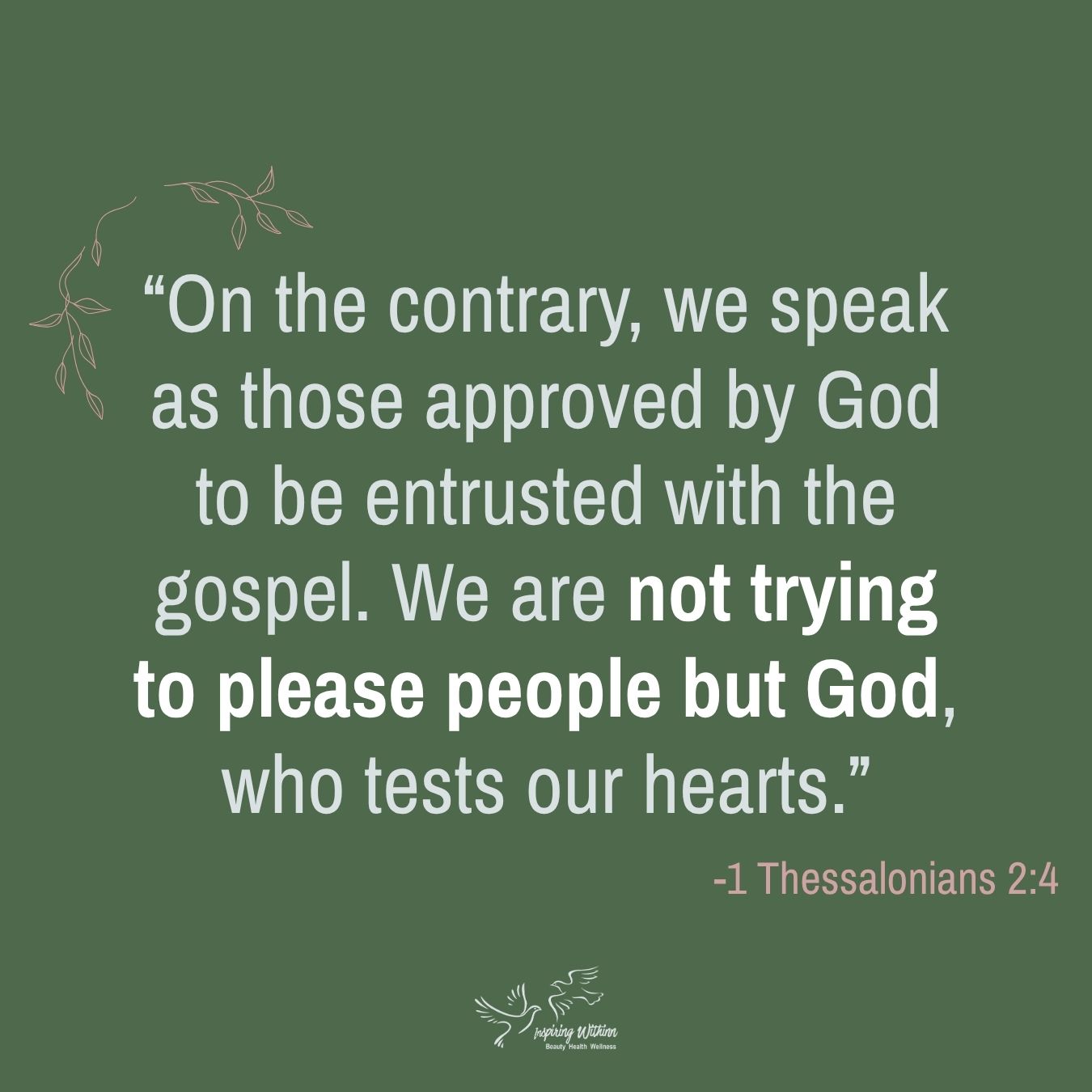
On the contrary, we speak as those approved by God to be entrusted with the gospel. We are not trying to please people but God, who tests our hearts. — 1 Thessalonians 2:4
How to Stop Compromising Who God Called You to Be
Once you recognize the ways you’ve been compromising yourself for others, it’s time to make a change. Start with your spiritual health because when you strengthen your relationship with God, that growth often carries into every other area of your health and wellness. More importantly, prioritizing your spiritual health keeps you aligned with God and obedient to what He has called you to do.
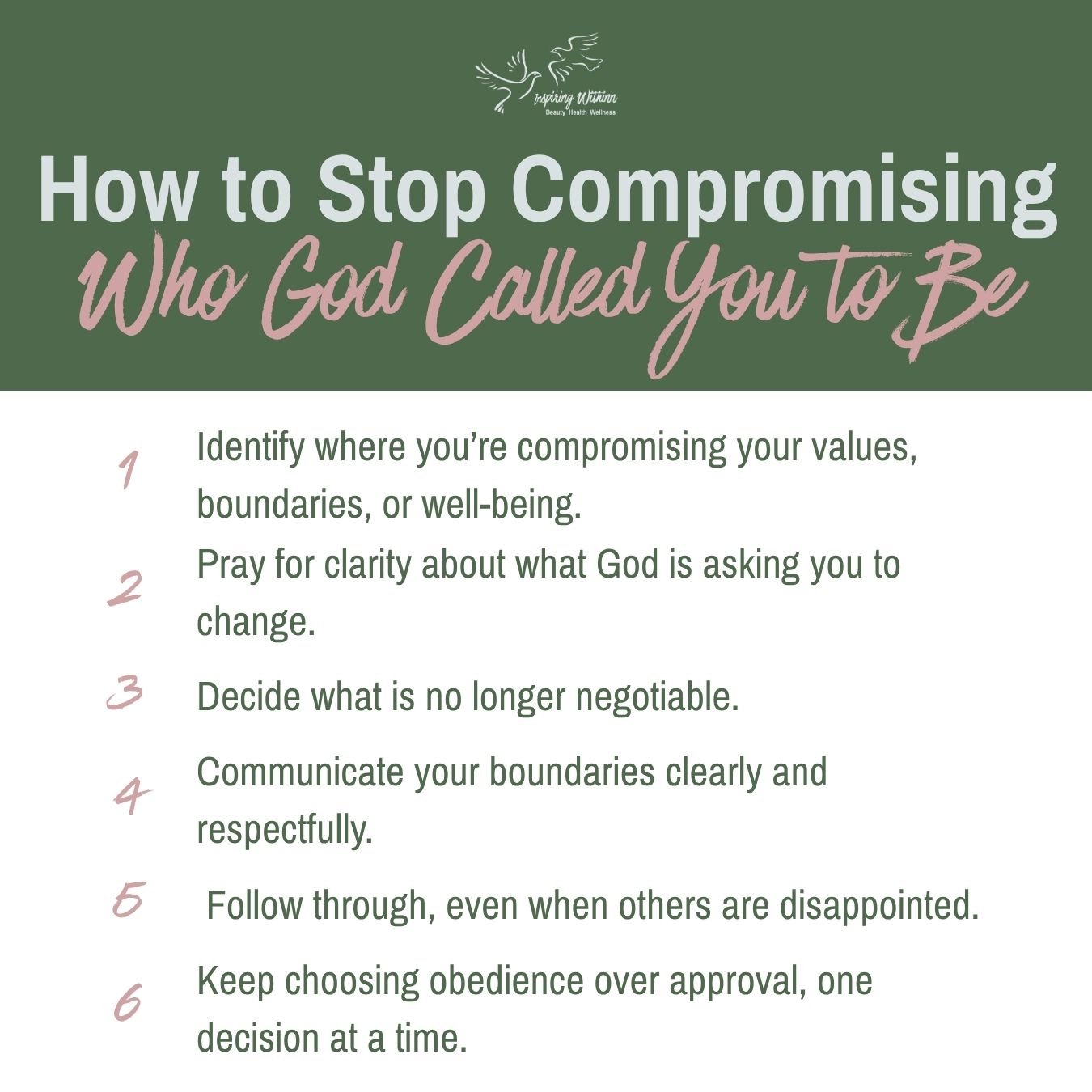
So, how do you stop compromising your values and start living as the person God created you to be? Here are my tips:
Step One: Identify where you’re compromising your values, boundaries, or well-being.
Pay attention to the moments when you say yes even though you want to say no, stay silent about something you believe, or continually sacrifice your well-being to avoid upsetting someone. Consider writing down the relationships or situations where you feel resentful, drained, anxious, or unlike yourself. These feelings can help you recognize where compromise has become a pattern.
Step Two: Pray for clarity about what God is asking you to change.
Bring these patterns honestly before God and ask Him to reveal where you’ve prioritized approval, comfort, or keeping the peace over obedience. Pray for the wisdom to recognize what needs to change and the courage to act on what He shows you. You don’t have to figure everything out on your own.
Step Three: Decide what is no longer negotiable.
Clearly define the values, convictions, and boundaries you’re no longer willing to compromise. This might involve how you spend your time, what behavior you accept, how you care for your body, or whether you participate in something that conflicts with your faith. Making these decisions beforehand can help you remain firm when pressure comes.
Step Four: Communicate your boundaries clearly and respectfully.
Tell others what you need, what you will no longer participate in, or what will change moving forward. You can be kind without over-explaining, apologizing, or asking permission to protect your well-being. Speaking the truth in love means communicating with both honesty and respect.
Step Five: Follow through, even when others are disappointed.
A boundary means little without consistent action. Some people may push back, question your decision, or try to make you feel guilty, especially if they benefited from your lack of boundaries. Their disappointment doesn’t automatically mean you’re doing something wrong.
Step Six: Keep choosing obedience over approval, one decision at a time.
You probably won’t break a lifelong pattern of people-pleasing or self-abandonment overnight. But each time you honor your convictions instead of chasing someone else’s approval, you strengthen your faith and become more secure in who God called you to be. Focus on making the next obedient choice rather than changing everything at once.
Bonus Step: Seek support if you need it.
Recognizing unhealthy patterns is one thing, but changing them can be much harder, especially when they’ve shaped your relationships for years. A trusted mentor, counselor, or coach can help you identify where you’re stuck, establish healthy boundaries, and stay accountable as you make changes. If you’re ready for support becoming the healthiest, most aligned version of yourself, learn more about working with me through one-on-one coaching.
Choose alignment over approval.
You don’t have to abandon yourself to love others well. God didn’t call you to shrink your convictions, ignore your limits, or become whoever others need you to be. He called you to follow Him.
Changing these patterns may feel uncomfortable at first, but peace built on self-abandonment isn’t real peace. Keep choosing obedience over approval, one decision at a time, and trust God to strengthen you as you become more fully who He created you to be.
